Strength Training at Home Without Equipment: Starting Out With a Belly
Reading time: 7 minutes
You get up in the morning, see your belly in the mirror, and think: "Gym? Not with this body." I get it. But strength training at home without equipment is your solution: no stares, no expensive membership, no excuses. Bodyweight exercises work with a belly too, if you know how to start.
No BS: you don't need six-pack promises. You need a plan that works for your body. Today I'll show you what strength training at home realistically looks like when you don't want to look like a fitness influencer but simply want to get stronger, more flexible, and more confident.
Why Strength Training at Home Makes Sense for Beginners With a Belly
For many men with a belly, gyms are sheer horror. A 2019 study from the University of Giessen in Germany confirms it, showing that 67 percent of overweight men between 30 and 50 avoid physical activity in public spaces out of shame (source: University of Giessen, Institute of Sport Science).
Working out at home without equipment eliminates exactly this barrier. Nobody watches. Nobody comments. You can start in sweatpants, stop when it gets to be too much, and pick it up again next time. That's not a sign of weakness but of smarts.
Muscle building for beginners doesn't start with heavy weights. It starts with your own body weight. And yes, that's completely enough. Push-ups, squats, planks: these exercises build muscle, improve your posture, and make you look more self-assured on a date. Especially for your posture on a date, a stronger core shows right away.
The Three Most Important Bodyweight Exercises to Start
Forget complicated workout plans with 15 exercises. You need three basics that train your whole body. These three movements are the foundation for everything that comes after.
Knee Push-Ups: Chest and Arms Without the Shame
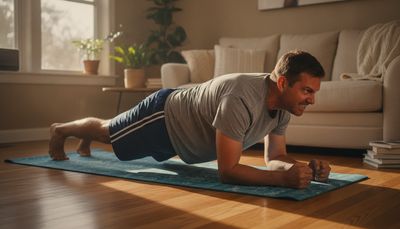
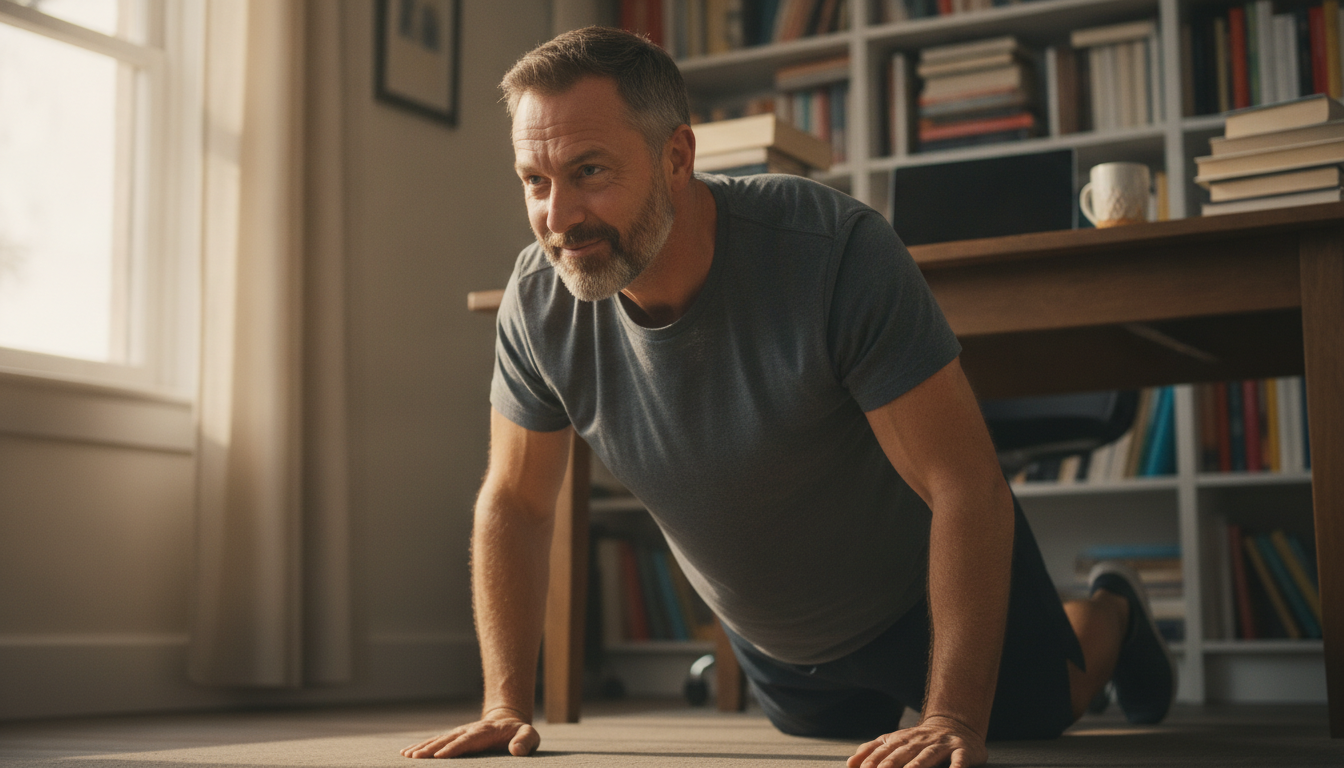
Regular push-ups? Forget them for now. Knee push-ups are your start. Hands shoulder-width on the floor, knees on the floor, body straight. Lower until your chest almost touches the floor, then push back up. Three sets of five reps are enough for week one.
Why it works: your upper body builds strength without you feeling overwhelmed. After two weeks you'll notice T-shirts fit better. After four weeks you might already manage a regular push-up.
Box Squats: Strengthen Your Legs With Control
Put a sturdy chair behind you. Feet shoulder-width, toes turned slightly out. Lower yourself in a controlled way until your butt touches the chair, then back up. Don't sit down, just tap it. Three sets of eight reps.
The beauty of it: the chair gives you security. You know how deep you can go without losing your balance. Your thighs and butt will burn, and that's a good thing.
Wall Plank: Core Stability Without Floor Contact
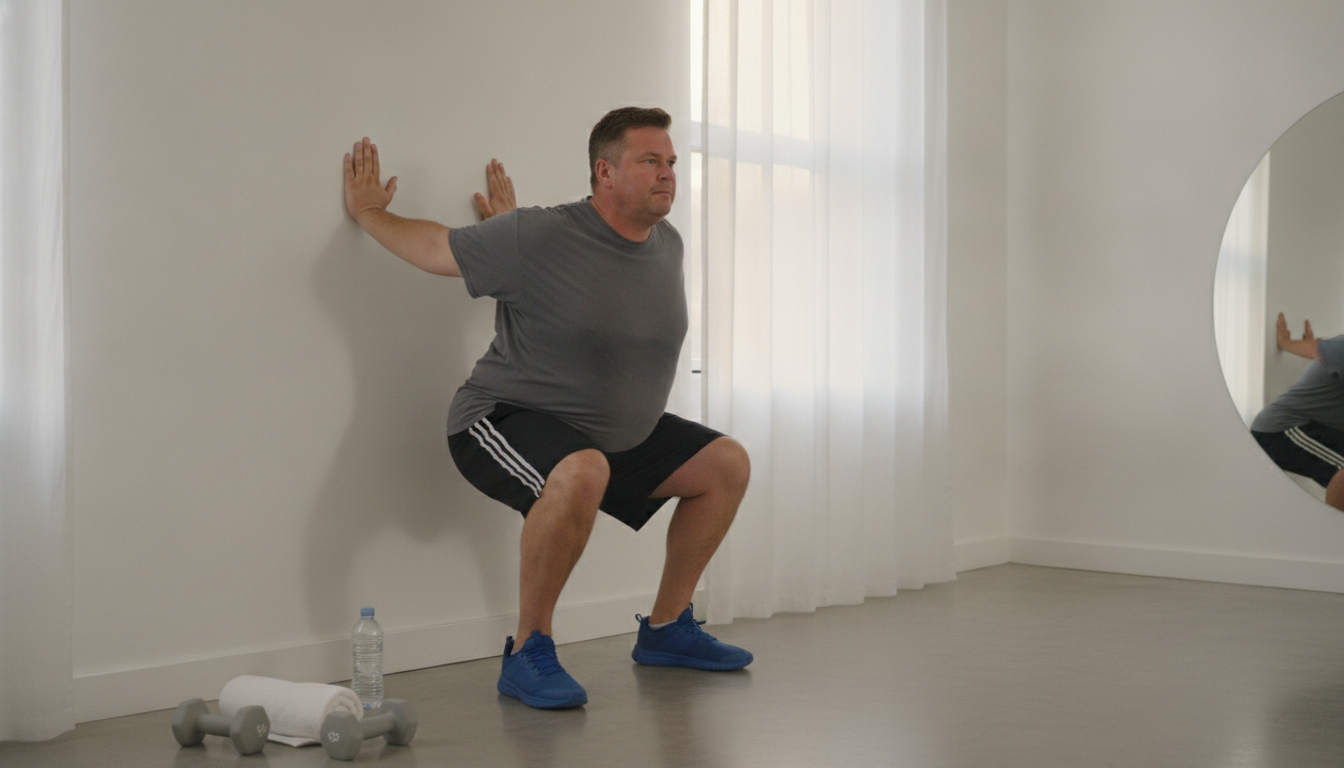
Regular planks on the floor are brutal when you have a belly. Try the wall plank instead: hands against a wall, body at an angle, feet about three feet from the wall. Hold the position for 20 seconds. Three rounds.
After a week you increase to 30 seconds. After two weeks you go deeper into the angle. Eventually you land at the classic plank on the floor, but without frustration at the start.
Your First 4-Week Plan for Strength Training at Home
A plan without clear structure is a waste of time. Here's how to start:
- Weeks 1-2: Three sessions a week, 15 minutes each. Knee push-ups (3x5), box squats (3x8), wall plank (3x20 seconds). 90 seconds of rest between sets.
- Weeks 3-4: Three sessions a week, 20 minutes each. Knee push-ups (3x8), box squats (3x12), wall plank (3x30 seconds). Cut rest down to 60 seconds.
- From week 5: Add new exercises like lunges or elevated push-ups. But only once the basics are solid.
Important: never train two days in a row. Your muscles grow during rest, not during the workout. Monday, Wednesday, Friday is a solid rhythm.
Common Mistakes in Home Workouts for Men With a Belly
You want too much at once. That's the most common mistake. A 45-minute workout with ten exercises sounds ambitious but ends in sore muscles and giving up after three days.
Second mistake: you compare yourself with people on YouTube who've been training for years. Their videos are advertising for their perfection, not your yardstick. Your yardstick is you four weeks ago.
Third mistake: you ignore nutrition. Strength training at home builds muscle, but if you keep knocking back three beers and a pizza every evening, you'll get stronger under a thicker layer of fat. That doesn't mean radical dieting, but maybe choosing more consciously in the work cafeteria.
Building Muscle Without a Gym: What You Really Need
Equipment to start: zero dollars. Later you can pick up a few things that make training more varied, but for the first eight weeks your body, a chair, and a wall are enough.
If you find after a month that you enjoy it: a pair of 20-pound dumbbells (about $40 at a big-box store like Walmart) and a resistance band ($15) expand your options enormously. But only buy them once you've proven you'll stick with it.
Time: 15 to 20 minutes, three times a week. That's not even two hours a week. Less than an average episode on Netflix. No excuse.
Strength Training for Overweight Beginners: What to Watch For
Your belly isn't a disability, but it does change the mechanics of some exercises. On squats you may not get as deep as slim guys. Doesn't matter. Go as deep as feels good.
On push-ups, more weight rests on your wrists. If they hurt, put a folded blanket under your hands or do the exercise on an elevated surface like the edge of a table.
Breathe consciously. Many beginners hold their breath because they're focused on the movement. That leads to dizziness and blood pressure spikes. Rule of thumb: exhale on the effort, inhale on the release.
If you're over 40 or have pre-existing health conditions, talk to your doctor first. After 40, certain blood values should be checked before you start exercising.
From Home Workouts to More Confidence in Everyday Life
After four weeks of consistent training you won't look like a cover model. But you'll move differently. Sit more upright. Carry yourself with more composure. Others notice, even if they don't know why.
In sugar dating, exactly that can make the difference. Not washboard abs, but the energy you radiate when you know you're working on yourself. That inner security is more attractive than any diet transformation.
Strength training at home isn't a sprint. It's a marathon in which you get a little better every week. And if you skip a week because life gets in the way, you simply get back in. No drama.
Staying Motivated Without Gym Pressure
Lack of motivation is the killer of every home workout. Without a trainer, without class times, without a paid membership, it's easy to just not start.
My tip: set a fixed time. Not "sometime in the evening," but "Monday, Wednesday, Friday at 7 p.m." Set an alarm. Treat it like an appointment.
Second tip: track your progress. Write down in a simple notes app how many reps you managed. After four weeks you see in black and white that you've improved. That motivates more than any motivational quote.
Third tip: be clear about why you're doing this. Not for Instagram, not for the mirror, but for yourself. So that on your next date you're not thinking about your belly but about the conversation. So that you feel more comfortable in your body, no matter what the scale says.
If you do hit a plateau anyway, that's completely normal. Progress is never linear.
FAQ: Strength Training at Home Without Equipment
Can I really build muscle with bodyweight exercises?
Yes, bodyweight exercises build muscle, especially as a beginner. Your body weight is enough resistance for the first few months. Later you can raise the intensity with variations.
How often should I do strength training at home as a beginner?
Three sessions a week are enough to start. Your muscles need rest to grow. More isn't automatically better when you're just starting out.
What do I do if I can't manage regular push-ups?
Start with knee push-ups or do them on the edge of a table. Any variation you can do with good form is better than a sloppy regular push-up.
Do I need a special diet for building muscle without a gym?
You need enough protein (about 1.6 grams per kilogram of body weight, or 0.73 grams per pound, according to studies from the German Nutrition Society) and enough calories. No miracle shakes, just normal, protein-rich meals.
How long until I see results?
After four weeks you feel stronger. After eight weeks you see first changes in posture and tone. Visible muscle takes months, but the better body awareness comes sooner.
Conclusion: Strength Training at Home Starts in Your Head, Not in the Gym
Strength training at home without equipment works when you stay realistic. Three exercises, three sessions a week, four weeks of patience. That's all you need to begin.
You won't become an athlete overnight. But you'll get stronger, more flexible, more confident. You'll feel it climbing stairs, on a date, looking in the mirror. And that's worth more than any six-pack.
Start today. Not tomorrow, not next Monday. Today. Three sets of knee push-ups. Now. You can do this.